




Report Interpretation
Understanding What Your Assessment Findings Mean
Report interpretation helps you understand the reasoning behind your AI Project Risk assessment—not just read its conclusions.
A finding may describe a potential weakness, an unresolved dependency, or an important information gap. Understanding that distinction helps your team judge what the report establishes, what remains uncertain, and how to interpret the recommended action.
Each finding should be read in the context of the project information and questionnaire responses supplied for that assessment.
Reading a Finding Correctly
What Was Reported
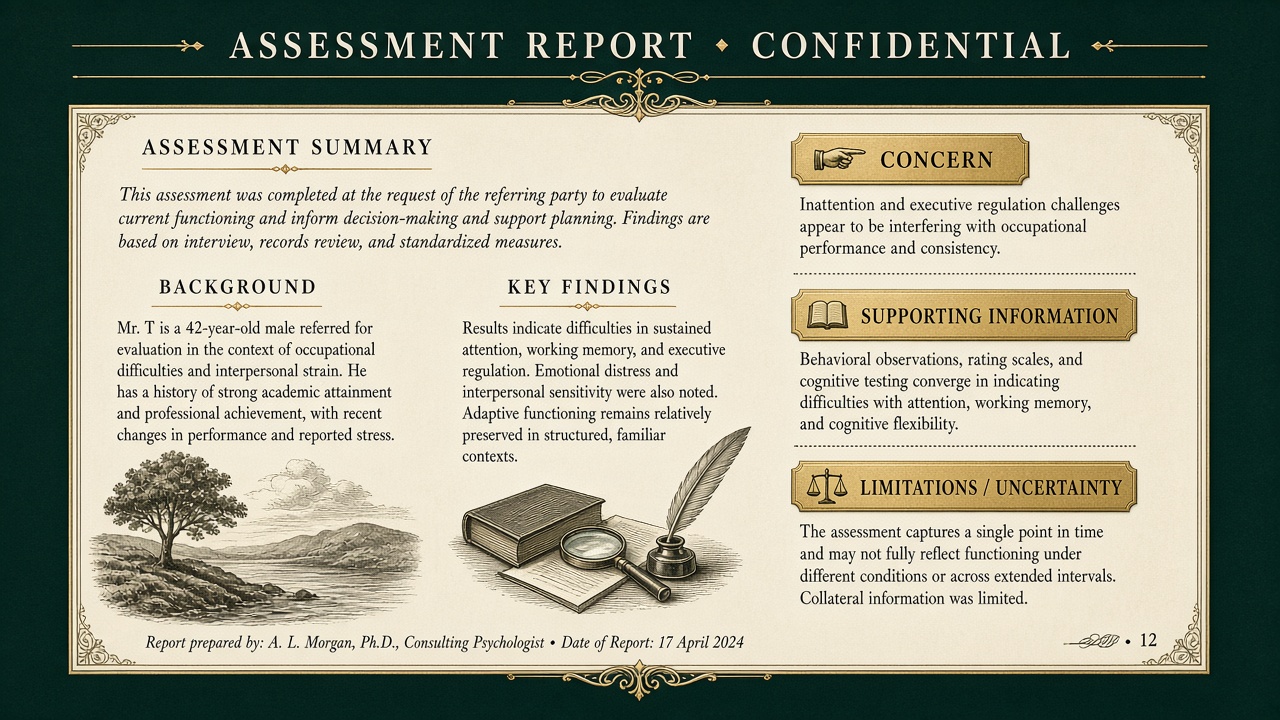
This is information your team supplied about the initiative, such as its objectives, current arrangements, or existing controls. For example, “A supervisor reviews the agent’s outputs” describes a reported practice. It does not independently establish how consistently or effectively that review operates.
What Was Inferred
A potential risk is an analytical conclusion drawn from the supplied information. For example, if outputs are reviewed only after customers receive them, the assessment may identify the possibility that incorrect guidance reaches customers before a reviewer can intervene. That describes a plausible exposure—not confirmation that an incident has occurred.
What Remains Unclear
Some findings depend on details that were not provided or were open to interpretation. “Approval arrangements were not described” is different from “Approval arrangements do not exist.” The appropriate response may be to clarify the arrangement rather than introduce a new control.
Understanding Potential Impact
An impact statement explains what could happen if a potential risk materializes. It is not a prediction that the consequence will occur.
For example, a finding may explain that unreliable answers could increase staff rework and reduce expected time savings. That connection helps explain why the concern matters to the initiative’s objectives.
Where the report indicates priority, read it alongside the stated reasoning, project context, and uncertainty. A concern can deserve attention because its possible consequences are significant, even when the available information is insufficient to establish how likely it is.
Interpreting Recommended Actions
A recommendation should be understood in relation to the concern it addresses. Not every recommendation calls for a technical change.
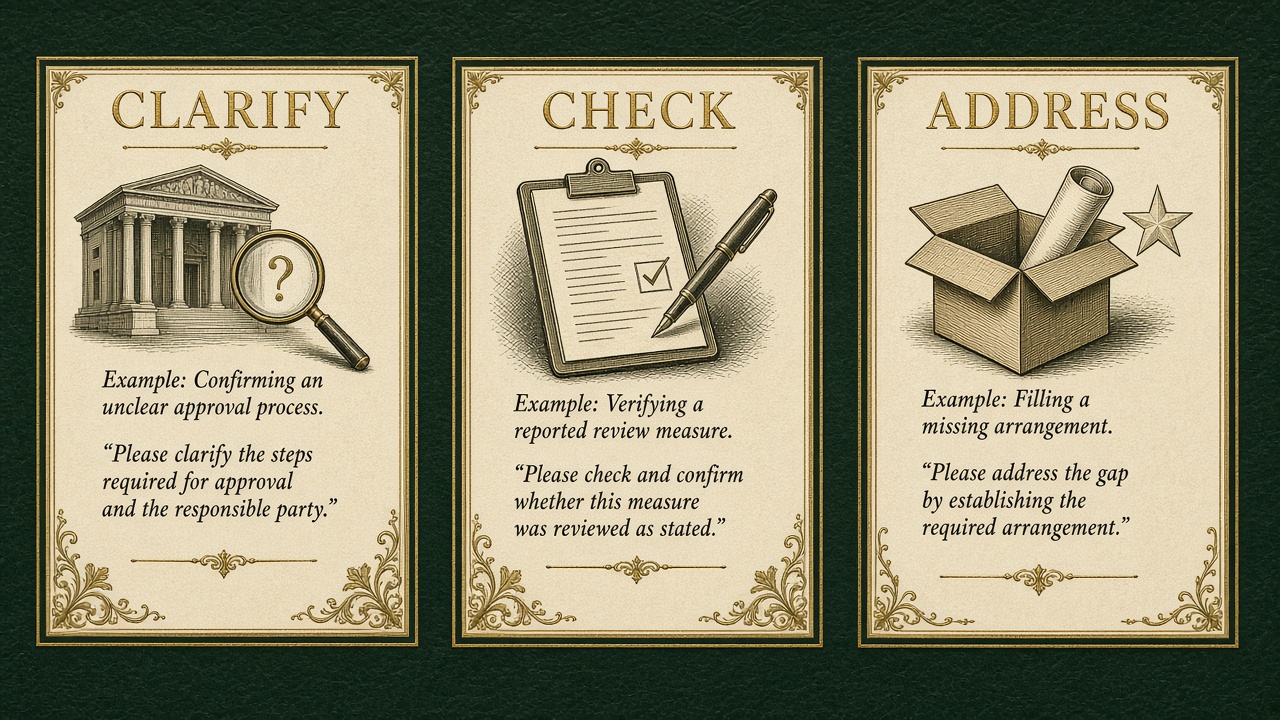
Clarify an Arrangement
Confirm a responsibility, process, or control that was unclear in the submitted responses.
Check an Existing Measure
Establish whether a reported measure works as intended, rather than assuming its presence is sufficient.
Address a Reported Gap
Consider a practical change where the supplied information indicates that an important arrangement is missing or incomplete.
These distinctions help avoid unnecessary work. A request to confirm an approval process should not automatically be interpreted as a recommendation to replace it.
When a Finding Does Not Match Your Understanding
If a finding appears inaccurate or overlooks an existing measure, compare its stated basis with the information originally submitted.
The difference may arise because:
- A response was ambiguous
- Relevant information was not included
- The assessment misinterpreted a response
- The initiative changed after the snapshot
These situations require different treatment. An interpretation error may warrant correction, while a later project change is new information outside the original assessment.
Keep the Snapshot in View
Your report describes potential risks apparent from one set of responses at one point in time.
It should not be read as independent verification of the implementation, confirmation that every risk has been found, or assurance that an unmentioned area is free of concerns.
Its value lies in making the reported conditions, analytical reasoning, and remaining uncertainties understandable—so your team can consider the recommendations on an informed basis.