




Payments and Fintechs

Payments firms and fintech companies often adopt AI at speed — across fraud detection, transaction monitoring, onboarding, customer support, credit decisioning, compliance operations, dispute handling, product analytics, and platform automation.
That speed can create advantage. It can also create exposure where AI affects regulated activity, sensitive data, transaction flows, customer outcomes, vendor reliance, or operational resilience.
AI Project Risk helps payments and fintech businesses assess active AI projects already in pilot, procurement, implementation, or production. We evaluate the project’s current risk position, review available project evidence, incorporate sponsor and executive context, and reference relevant benchmarks to identify where controls, governance, or oversight may need strengthening.
The result is a concise executive view of AI project exposure, practical risk priorities, and recommended management actions.
AI Risk Assessment for Fast-Moving Financial Platforms
Payments and fintech environments are highly data-driven, transaction-heavy, and technology-dependent. AI projects may be introduced quickly through internal product teams, fraud engines, compliance tools, customer platforms, analytics models, vendor APIs, cloud services, or embedded AI features.
The executive challenge is to maintain innovation speed while ensuring that AI-enabled processes remain controlled, explainable, secure, resilient, and aligned with regulatory expectations.
AI Project Risk supports assessment of active AI projects across areas such as:
- Fraud detection and transaction risk scoring
- AML, sanctions, and suspicious activity monitoring support
- Customer onboarding, KYC, and identity verification
- Dispute handling and chargeback analysis
- Credit, affordability, or lending decision support
- Customer service chatbots and response automation
- Product personalisation and customer segmentation
- Merchant risk monitoring and account review
- Payment operations, reconciliation, and exception handling
- Platform monitoring, anomaly detection, and operational automation
- Vendor AI tools, cloud AI services, and embedded AI capabilities
The assessment helps management understand whether the AI project is creating scalable value without introducing unmanaged risk.
Key Risk Questions for Payments and Fintech Executives
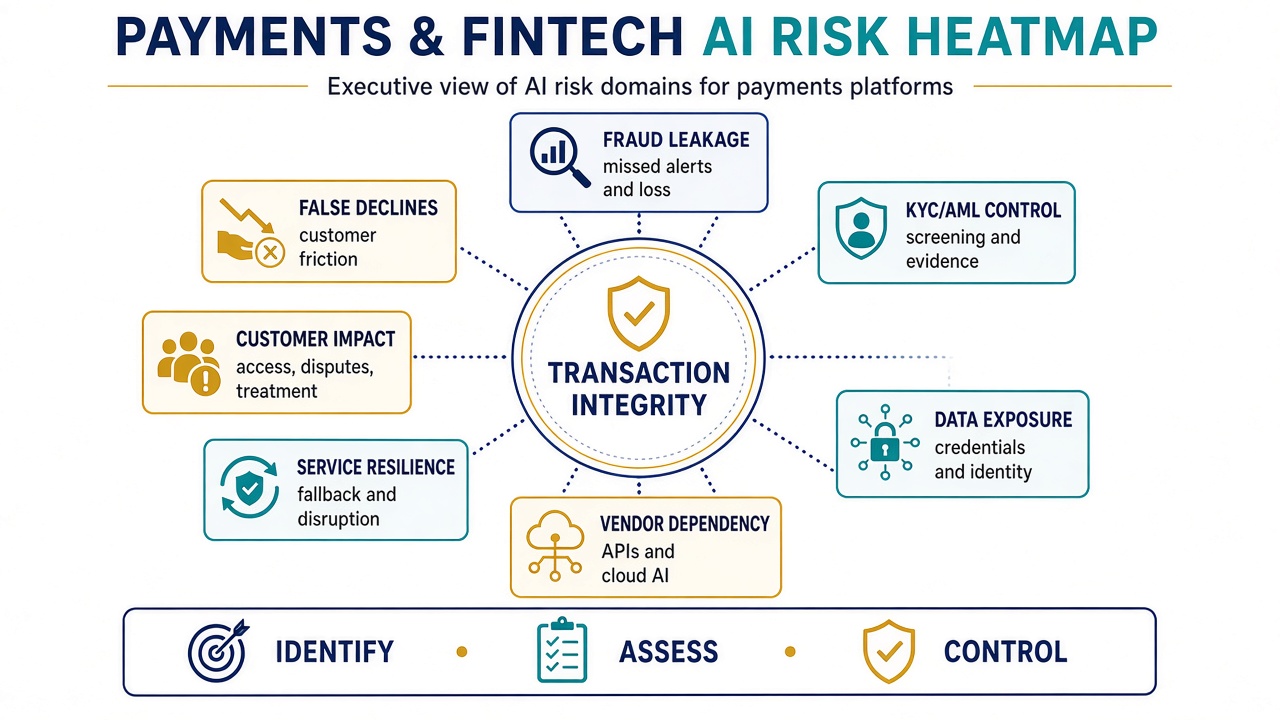
Could AI affect transaction integrity or fraud exposure?
We assess whether the AI project influences fraud alerts, transaction holds, risk scores, account restrictions, merchant monitoring, dispute outcomes, or suspicious activity workflows.
Are compliance controls keeping pace with automation?
Where AI supports onboarding, screening, monitoring, reporting, or case prioritisation, we review whether oversight, evidence, escalation, and human review remain appropriate.
Is customer impact understood?
Payments and fintech AI projects may affect approvals, declines, account access, service responses, fees, disputes, complaints, collections, or customer treatment. We identify where outcome risk may require closer management attention.
Is sensitive data being used safely?
AI projects may involve payment credentials, transaction histories, device data, behavioural signals, identity records, financial data, merchant information, or confidential platform data. We consider whether data use, access, retention, and vendor exposure appear proportionate.
Can the AI-enabled process withstand disruption?
We review operational dependencies, fallback procedures, incident handling, service resilience, exception queues, manual override, and the ability to operate if the AI tool, model, integration, data feed, or vendor service fails.
Is embedded or vendor AI visible enough?
Many fintech and payments firms rely on external platforms, APIs, fraud vendors, identity providers, cloud infrastructure, and regtech tools. We assess whether AI functionality introduced through these channels is sufficiently understood and governed.
Relevant Payments and Fintech Risk Areas
Fraud, Transaction Monitoring, and Merchant Risk
Review of AI used to detect fraud, score transactions, prioritise investigations, monitor merchants, identify anomalies, or reduce financial loss.
Onboarding, KYC, AML, and Sanctions Support
Assessment of AI projects supporting identity verification, document review, screening, alert triage, customer due diligence, enhanced due diligence, or suspicious activity review.
Customer Operations and Disputes
Review of AI applied to customer service automation, complaint handling, dispute routing, chargeback analysis, account servicing, or support quality.
Credit, Lending, and Affordability
Assessment of AI used by fintech lenders or embedded finance providers for decision support, risk scoring, collections prioritisation, affordability review, or portfolio monitoring.
Platform Operations and Resilience
Review of AI embedded in payment processing, exception management, reconciliation, service monitoring, anomaly detection, incident response, and operational automation.
Third-Party and Cloud AI Dependencies
Assessment of AI delivered through vendors, APIs, data providers, identity platforms, fraud tools, cloud services, outsourced operations, or embedded software functionality.
Executive Outputs
Typical outputs for payments and fintech clients include:
- Payments or Fintech AI Project Risk Summary
- Fraud, Transaction, and Financial Loss Risk Observations
- Compliance Workflow and Control Findings
- Customer Outcome and Conduct Risk Notes
- Data Sensitivity and Security Risk Indicators
- Vendor, API, and Cloud AI Dependency Review
- Operational Resilience and Fallback Assessment
- Governance and Accountability Observations
- Benchmark Reference Notes
- Priority Management Actions
- Remediation Roadmap
- Executive or Committee Briefing Summary, where required
These outputs help executives decide whether an active AI project can scale safely, requires additional controls, should be restricted, or needs escalation before broader reliance.
Benchmark and Regulatory References
Where relevant, observations may be informed by AI governance, operational resilience, payments risk, financial crime, data protection, model risk, cybersecurity, outsourcing, and third-party risk management benchmarks.
References may include the NIST AI Risk Management Framework, EU AI Act readiness considerations, model risk management principles, payment services regulatory expectations, AML and sanctions control practices, data security standards, outsourcing guidance, and three-lines-of-defense governance models.
Benchmark references support management assessment and prioritisation. They are not presented as legal advice, regulatory approval, audit assurance, certification, or formal compliance determination.
Request an Executive Briefing
If your payments or fintech business has active AI projects in fraud, compliance, onboarding, customer operations, lending, platform automation, or vendor-enabled services, AI Project Risk can provide a focused assessment of exposure, controls, and remediation priorities.