




Private Equity and Portfolio Management Companies

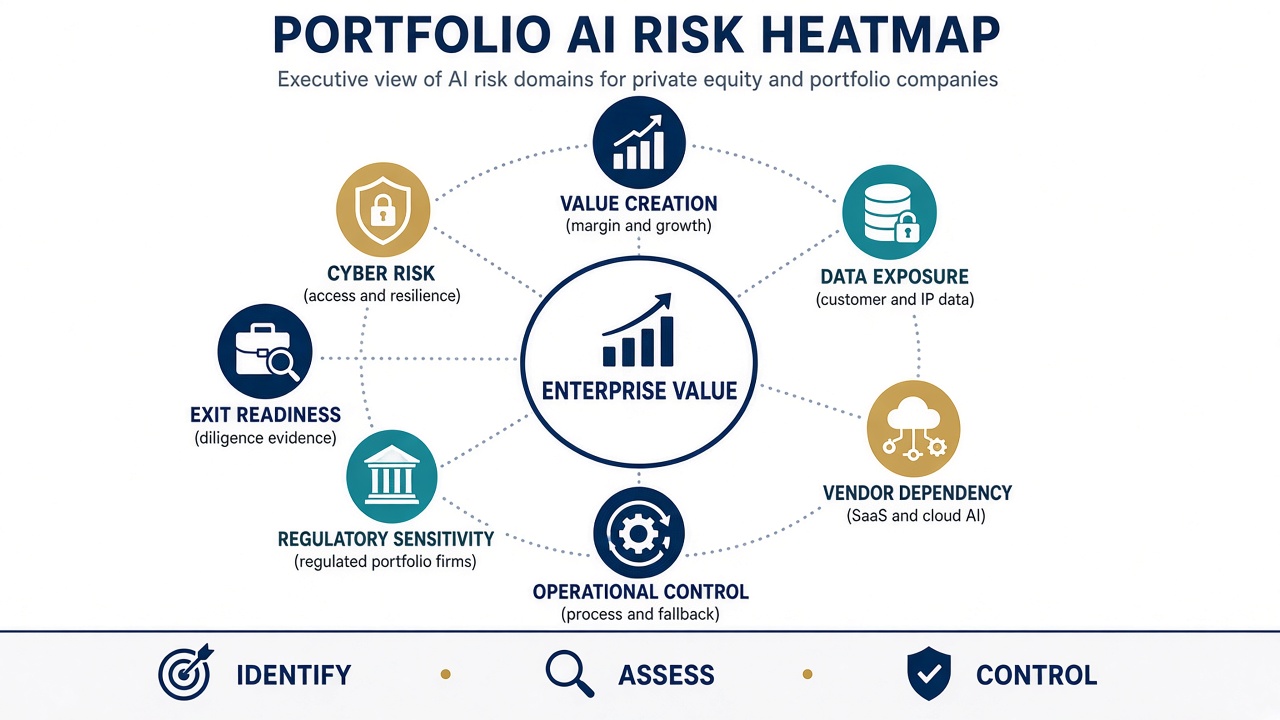
Private equity sponsors and portfolio company leaders are accelerating AI adoption to improve productivity, margin expansion, customer operations, compliance efficiency, pricing, analytics, software capability, and enterprise value creation.
AI can also introduce risk across the portfolio when projects are launched without consistent governance, data controls, vendor oversight, model discipline, or board visibility.
AI Project Risk helps private equity firms and portfolio companies assess active AI projects in pilot, procurement, implementation, or production. We evaluate the project’s current risk position, available evidence, management context, and relevant benchmarks to identify exposure, control gaps, and remediation priorities.
The result is a concise view of whether an AI project supports value creation without creating avoidable operational, regulatory, cyber, data, vendor, financial, or reputational risk.
AI Risk Assessment for Portfolio Value Creation
For private equity, AI risk is not only a compliance issue. It is also a value creation, operational resilience, diligence, and exit-readiness issue.
An AI project may improve EBITDA, reduce manual work, increase sales conversion, enhance customer service, automate back-office activity, or improve fraud and loss detection. But if poorly governed, the same project may create data exposure, vendor dependency, customer harm, weak controls, unreliable outputs, regulatory concern, or issues during buyer diligence.
AI Project Risk supports assessment of active AI projects across areas such as:
- AI-enabled operational efficiency programmes
- Customer service automation and contact centre tools
- Sales, marketing, and pricing optimisation
- Claims, credit, payments, or transaction workflows
- Fraud detection and revenue leakage prevention
- Compliance, monitoring, and reporting automation
- Finance, HR, legal, and internal productivity tools
- Software products with embedded AI functionality
- Vendor AI tools adopted across portfolio companies
- AI initiatives identified during diligence or post-acquisition review
The assessment helps sponsors and management teams understand whether AI adoption is creating controlled enterprise value or unmanaged exposure.
Key Risk Questions for PE Sponsors and Portfolio Executives
Does the AI project support the investment thesis?
We assess whether the project is linked to a clear commercial objective, such as margin improvement, revenue growth, risk reduction, faster execution, improved customer service, or operational scalability.
Could the project create hidden enterprise risk?
AI initiatives may begin at department level but affect customer processes, regulated activity, sensitive data, financial controls, cyber exposure, vendor reliance, or product liability. We identify indicators that may require senior attention.
Is governance consistent with company maturity?
Portfolio companies vary in size, sophistication, and regulatory exposure. We assess whether oversight is proportionate to the company’s operating model, industry risk, customer impact, and stage of AI adoption.
Are data and confidentiality risks controlled?
AI projects may use customer records, payment data, employee information, pricing data, contracts, intellectual property, financial information, or confidential commercial data. We review whether data exposure appears understood and controlled.
Are vendors creating dependency or exit risk?
Many portfolio companies use AI through SaaS platforms, cloud services, analytics tools, customer systems, productivity suites, and outsourced providers. We assess where vendor opacity, contract gaps, resilience concerns, or switching constraints may affect risk and valuation.
Would the AI project withstand diligence?
For companies preparing for refinancing, acquisition, or exit, we consider whether the AI project has sufficient evidence of ownership, controls, vendor assurance, data governance, monitoring, and issue management.
Relevant Private Equity and Portfolio Risk Areas
Post-Acquisition AI Review
Assessment of active AI projects discovered after acquisition, including undocumented tools, business-unit pilots, vendor-enabled AI, and automation initiatives already affecting operations.
Portfolio-Wide AI Governance
Review of recurring AI risk themes across multiple portfolio companies, supporting sponsor-level oversight, reporting consistency, and prioritised intervention.
Operational Improvement and Margin Expansion
Assessment of AI used to automate workflows, reduce manual effort, improve service levels, accelerate processing, reduce leakage, or enhance management information.
Regulated Portfolio Companies
Review of AI projects in portfolio companies operating in financial services, insurance, lending, payments, healthcare, data services, or other regulated markets.
Software and AI-Enabled Products
Assessment of embedded AI features in portfolio company products, including customer impact, data usage, explainability, monitoring, contractual obligations, and product governance.
Exit and Diligence Readiness
Review of whether AI initiatives are sufficiently documented, controlled, and explainable for buyer diligence, lender review, board reporting, or regulatory inquiry.
Executive Outputs
Typical outputs for private equity and portfolio company clients include:
- Portfolio Company AI Project Risk Summary
- Value Creation and Risk Alignment Observations
- Governance and Accountability Findings
- Data, Confidentiality, and Cyber Risk Indicators
- Vendor and SaaS AI Dependency Review
- Operational Control Gap Summary
- Regulated Activity and Customer Impact Notes
- Exit or Diligence Readiness Observations
- Benchmark Reference Notes
- Priority Management Actions
- Remediation Roadmap
- Sponsor or Board Briefing Summary, where required
These outputs help sponsors, boards, and management teams decide whether an AI project should be accelerated, strengthened, limited, remediated, or escalated.
Benchmark and Governance References
Where relevant, observations may be informed by AI governance frameworks, operational risk practices, data protection standards, cybersecurity controls, third-party risk expectations, model risk principles, regulatory guidance, and board oversight models.
References may include the NIST AI Risk Management Framework, EU AI Act readiness considerations, model risk management principles, outsourcing and vendor risk practices, operational resilience standards, and three-lines-of-defense governance models.
Benchmark references support structured assessment and prioritisation. They are not presented as legal advice, regulatory approval, audit assurance, valuation opinion, investment advice, or formal compliance determination.
Request an Executive Briefing
If your fund or portfolio company has active AI projects that may affect value creation, risk exposure, diligence readiness, or regulated operations, AI Project Risk can provide a focused assessment of current exposure and remediation priorities.