




Pillar Stages
Five Areas That Shape an AI Initiative
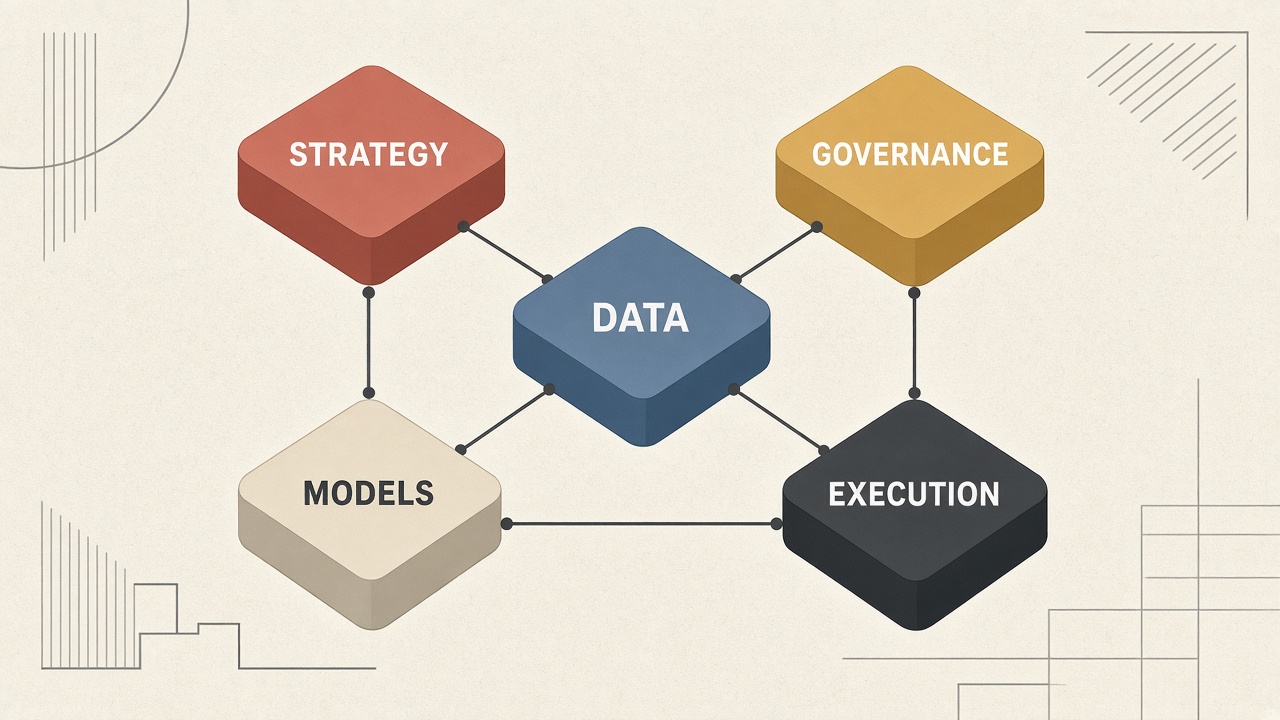
The AI Project Risk platform organizes its assessment around five pillar stages: Strategy, Governance, Data, Models, and Execution.
These pillars provide a structure for examining the main areas of an AI initiative’s workflow—from its intended purpose to the arrangements needed to put AI capabilities into practice.
Although we call them stages, they are not a rigid sequence. Work across these areas often overlaps, and a change in one can affect the others. Our assessment considers the pillars in the context of the project snapshot you provide.
Strategy: Purpose and Expected Value
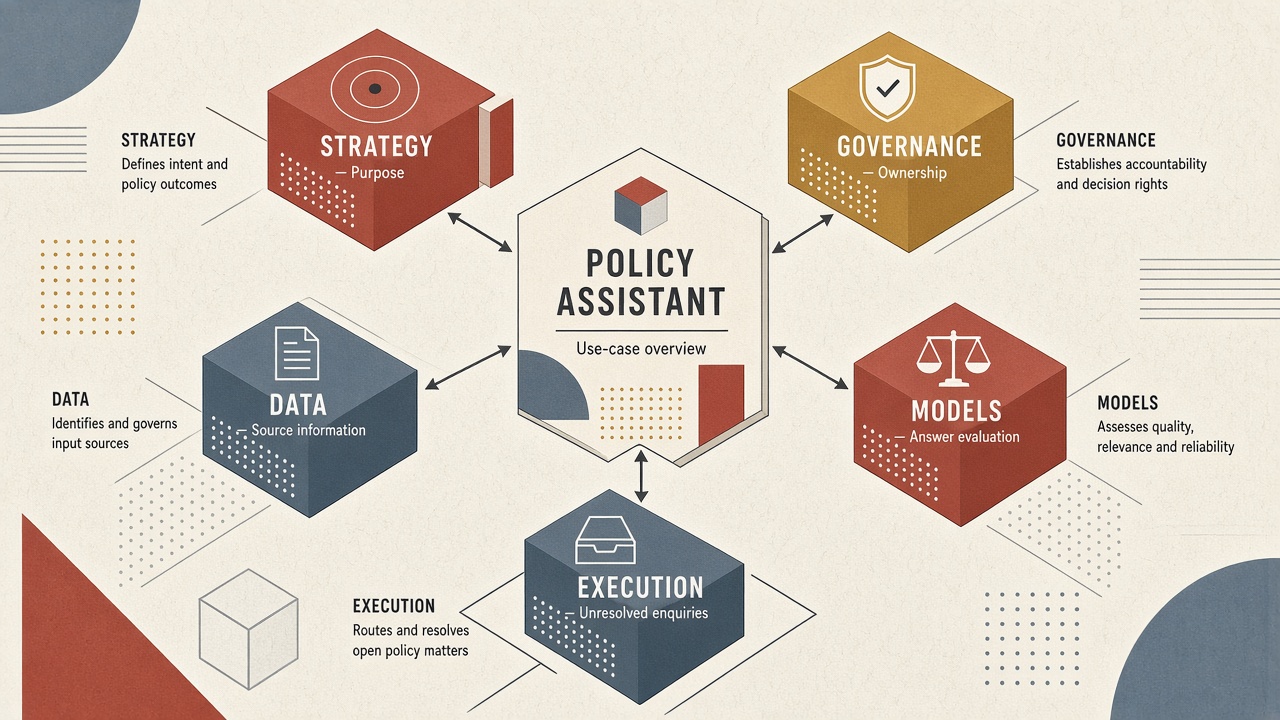
Strategy concerns what the initiative is intended to achieve and how its contribution will be understood. This includes the business problem being addressed, the expected outcome, the proposed role of AI, and the measures used to evaluate progress. The assessment considers whether these elements support one another. For example, a project intended to reduce processing effort needs measures that reveal changes in workload—not just how often the AI is used.
Governance: Responsibility and Oversight
Governance concerns who is responsible for the initiative and how its activities are directed, controlled, and reviewed. This includes reported ownership, approval arrangements, limits on agent actions, human oversight, and procedures for escalating problems. The assessment considers whether these arrangements fit the activities described. An agent that recommends an action and an agent that carries it out may require different controls.
Data: Information the Initiative Depends On
Data concerns the information an AI solution needs to perform its intended task. Depending on the use case, this may include business records, reference documents, user inputs, or information retrieved from other systems. The assessment considers reported arrangements for availability, relevance, quality, freshness, and appropriate access. It also looks for uncertainty about how missing or conflicting information is handled. For example, access to a large document collection does not necessarily mean an assistant can identify which policy is current and applicable.
Models: Capability and Evaluation
Models concerns the AI capabilities used to interpret information, generate outputs, or support actions. The assessment considers how the reported capabilities and limitations relate to the intended task, and whether evaluation practices are appropriate to that task. A model that produces convincing answers does not necessarily perform reliably across the situations the initiative must handle. Relevant evaluation needs to consider more than the appearance of individual outputs.
Execution: Putting the Initiative Into Practice
Execution concerns how the initiative works within the organization’s actual processes. This includes integrations, human involvement, exception handling, operating responsibilities, user adoption, and the effort required to maintain useful results. The assessment considers whether the reported working arrangements support the expected outcome. For example, an automated task may offer limited savings if its outputs routinely require substantial manual correction.
Why the Connections Matter
A potential risk may originate in one pillar and affect several others.
For example, outdated source information is a Data concern. Whether someone is responsible for replacing it involves Governance. Whether outdated answers are detected involves Models and Execution. The effect on the initiative’s expected benefit connects back to Strategy.
Considering these relationships helps avoid treating project concerns as isolated issues.
A Framework Applied to Your Snapshot
The five pillars guide the analysis; they do not imply access to your internal systems or detailed technical specifications.
Findings are based on the project information and questionnaire responses you provide. Where a pillar is insufficiently described, the assessment should identify that limitation rather than assume the relevant arrangements are absent.
Together, the pillars provide a consistent way to examine the reported initiative while keeping its purpose, current stage, and available information in view.
- Strategy, Governance, Data, Models, and Execution
- Connected areas of work, not a rigid sequence
- Applied to the project snapshot you provide
- A missing description is a limitation, not proof that an arrangement is absent