





Executive Decisions
Turning Project Details Into Executive-Relevant Findings
“Executive Decisions” describes how our assessment translates project information into findings that responsible executives can understand and consider.
The focus is not on making decisions for your organization. It is on explaining why a potential risk matters to the initiative’s objectives, what its consequences could be, and what action may help address it.
The assessment reflects the reported project snapshot. It does not determine whether your organization should fund, launch, expand, or discontinue the initiative.

How the Assessment Builds Meaningful Results
Start With the Intended Outcome
Our assessment agents use your description of the initiative, expected outcomes, and performance measures to establish the business context.
A concern becomes more meaningful when connected to what the organization is trying to achieve—such as reducing processing effort, improving service quality, or increasing operational capacity.
This helps keep the analysis focused on your initiative rather than on generic AI concerns.
Identify Relevant Potential Risks
The agents examine the supplied responses across Strategy, Governance, Data, Models, and Execution.
For each material finding, the analysis should explain which reported conditions make the concern relevant. Where information is incomplete, the finding should acknowledge the uncertainty rather than present an assumption as fact.
Explain the Business Consequence
A technical or operational concern should be translated into a consequence an executive can understand.
For example, inconsistent outputs may mean additional review work. Unclear responsibility for exceptions may mean delays. Outdated reference information may mean incorrect guidance and avoidable corrections.
These are possible consequences—not predictions that the project will experience them.
Recommend a Proportionate Response
The recommended action should address the specific concern while accounting for the initiative’s reported stage and existing measures.
The appropriate response may be to clarify a responsibility, check an assumption, evaluate an existing control, or address a reported gap. Not every finding requires additional technology or a major project change.
An Example: From Performance Measure to Business Relevance
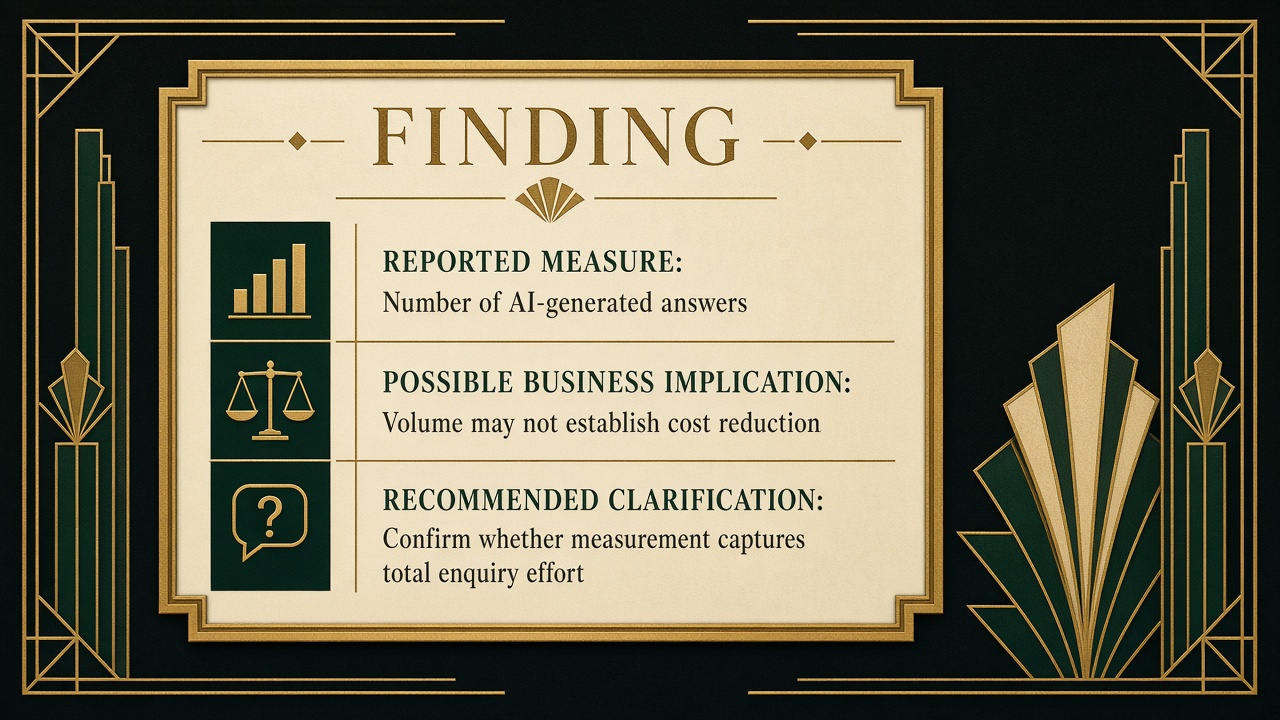
Suppose an initiative aims to reduce the cost of handling enquiries. The customer reports that progress is measured by the number of AI-generated answers, but does not describe how human review and correction are accounted for.
An executive-relevant finding would explain:
- The reported measure shows output volume, but may not establish cost reduction
- Review and correction effort could reduce the expected benefit
- The responsible team should confirm whether its measurement approach captures the total effort needed to complete enquiries
This does not establish that savings are absent. It explains why the supplied information may be insufficient to judge whether the intended benefit is being achieved.
Keeping Executive Attention on What Matters
A useful assessment should not give every possible concern equal prominence.
Findings should make clear why attention may be warranted, considering the possible consequence, relevance to current activities, reported mitigations, and remaining uncertainty.
Where several findings arise from the same underlying issue, their relationship should be explained rather than allowing repetition to suggest greater significance.
Supporting Judgment, Not Replacing It
Executives retain responsibility for deciding how to respond, using their knowledge of organizational priorities, resources, and circumstances.
Our role is to make the reasoning accessible: what raised the concern, why it could matter, what may reduce it, and what remains unknown.
The result should be a clearer basis for informed judgment—not an automated instruction or a guarantee of project success.