




Lending and Credit Providers

Lending and credit providers are using AI to improve origination, affordability assessment, underwriting support, credit monitoring, fraud detection, collections, customer communications, and portfolio management. These projects can strengthen speed and consistency, but they may also create exposure in credit decisioning, customer treatment, explainability, data governance, model oversight, and regulatory scrutiny.
AI Project Risk helps lenders, credit providers, specialty finance firms, embedded finance providers, and digital lending platforms assess active AI projects in pilot, procurement, implementation, or production. We evaluate the project’s current risk position, review available evidence, incorporate sponsor and executive context, and reference relevant benchmarks to identify material risk indicators and control priorities.
The result is a concise executive view of whether the AI project is suitably controlled for its role in lending and credit activity.
AI Risk Assessment for Lending and Credit Environments
AI in lending can sit close to regulated decisions and customer outcomes. Even when AI is not making the final decision, it may influence risk scores, affordability views, referral decisions, collections priority, fraud indicators, pricing support, or customer treatment.
For executives, the central question is whether the institution can evidence that AI-supported lending activity is fair, controlled, explainable, and aligned with risk appetite.
AI Project Risk supports assessment of active AI projects across areas such as:
- Credit decision support and underwriting workflow
- Affordability and income verification support
- Application triage and referral routing
- Fraud detection in loan origination
- Customer segmentation and pre-qualification
- Collections prioritisation and hardship identification
- Credit line management and account monitoring
- Portfolio risk analytics and early warning indicators
- Customer communication and servicing automation
- Embedded finance and partner lending platforms
- Vendor-provided credit models, data tools, or decision engines
The assessment helps management understand where AI may improve lending performance and where additional governance or controls may be required.
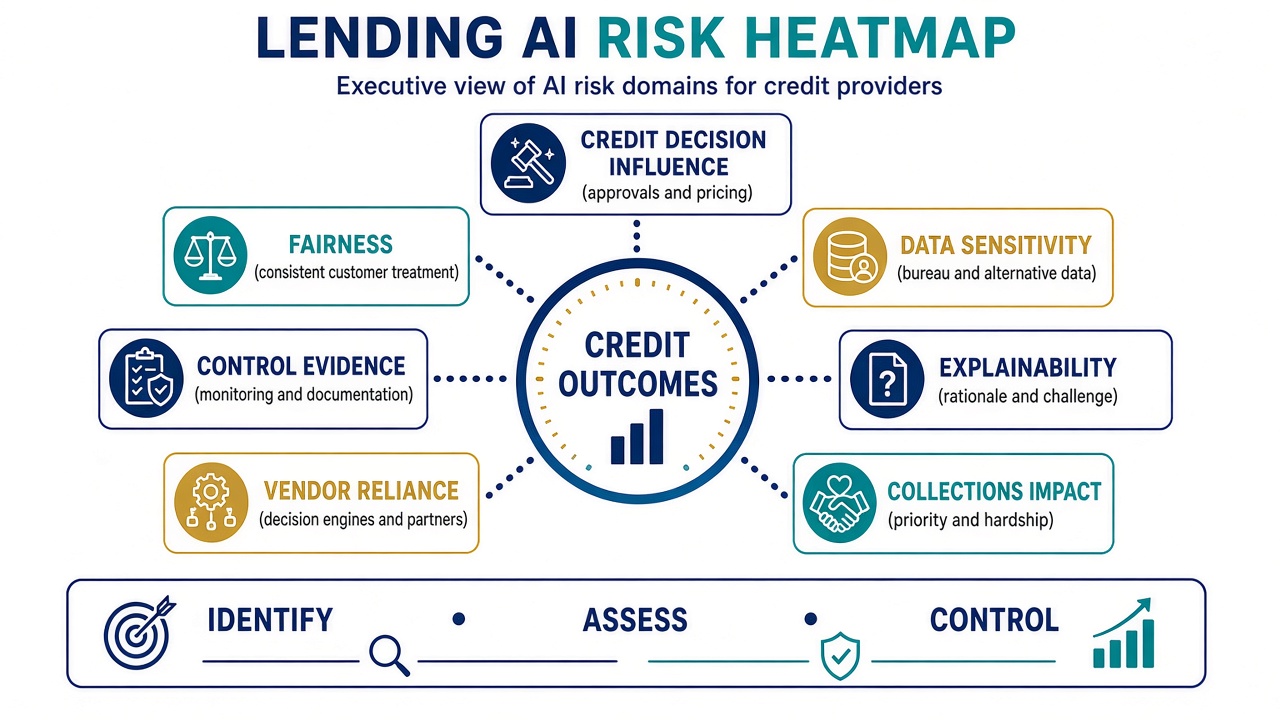
Key Risk Questions for Lending and Credit Executives
Could AI influence approval, decline, pricing, or customer treatment?
We assess whether the project affects credit decisions, eligibility, risk classification, pricing inputs, limit setting, collections strategies, hardship treatment, or servicing outcomes.
Is explainability sufficient for the business context?
Credit-related activity often requires clear rationale, challenge, documentation, and customer-facing defensibility. We consider whether AI outputs can be understood and governed at the right level.
Are fairness and conduct risks visible?
Where AI affects lending or collections activity, we identify indicators that may require review, including potential bias, inconsistent treatment, adverse outcomes, vulnerable customer considerations, complaints, or unclear override practices.
Is data use appropriate and controlled?
AI projects may use bureau data, bank transaction data, income data, behavioural signals, device data, alternative data, customer communications, employment information, or partner-supplied data. We assess whether sensitivity, relevance, access, retention, and vendor use require management attention.
Are model and score outputs monitored?
We review available evidence on performance monitoring, drift, false positives, false negatives, override rates, approval patterns, decline patterns, exception handling, and operational reliance.
Are third-party credit tools properly overseen?
Many lending AI projects rely on external data providers, decision engines, fraud tools, affordability platforms, embedded finance partners, or cloud AI services. We assess whether oversight and contractual controls appear proportionate.
Relevant Lending and Credit Risk Areas
Origination and Underwriting
Review of AI used to support application assessment, risk scoring, income verification, affordability checks, eligibility screening, referral decisions, or fraud detection.
Credit Policy and Portfolio Monitoring
Assessment of AI projects supporting credit line management, early warning signals, portfolio segmentation, delinquency prediction, stress indicators, or management reporting.
Collections and Customer Treatment
Review of AI applied to collections prioritisation, contact strategies, hardship detection, vulnerable customer identification, settlement recommendations, or arrears management.
Fraud and Identity Risk
Assessment of AI used to detect synthetic identity, application fraud, document manipulation, account takeover, mule activity, or suspicious borrower behaviour.
Customer Communications and Servicing
Review of AI-generated communications, servicing assistants, complaint summaries, chatbots, call centre tools, or personalised engagement.
Partner, Vendor, and Embedded Finance Models
Assessment of AI capabilities delivered through decision platforms, data providers, fintech partners, embedded finance arrangements, loan servicing vendors, or outsourced operations.
Executive Outputs
Typical outputs for lending and credit clients include:
- Lending AI Project Risk Summary
- Credit Decision Influence Assessment
- Fairness, Conduct, and Customer Treatment Observations
- Explainability and Documentation Findings
- Data Relevance and Sensitivity Review
- Model Output and Monitoring Observations
- Vendor, Partner, or Embedded Finance Risk Notes
- Operational Control Gap Summary
- Benchmark Reference Notes
- Priority Management Actions
- Remediation Roadmap
- Committee Briefing Summary, where required
These outputs help executives decide whether an active AI project is appropriate for current use, requires stronger controls, should be limited in scope, or needs escalation before wider deployment.
Benchmark and Regulatory References
Where relevant, observations may be informed by credit risk governance, model risk management, fair lending and conduct expectations, consumer protection principles, data governance standards, AI risk management frameworks, third-party risk practices, and operational resilience guidance.
References may include the NIST AI Risk Management Framework, EU AI Act readiness considerations, SR 11-7 model risk principles, fair lending and consumer credit expectations, FCA consumer duty considerations, credit risk governance standards, outsourcing guidance, and three-lines-of-defense models.
Benchmark references support structured review and prioritisation. They are not presented as legal advice, regulatory approval, audit assurance, credit approval, fair lending opinion, model validation, or formal compliance determination.
Request an Executive Briefing
If your lending or credit business has active AI projects in origination, underwriting, affordability, fraud, collections, servicing, portfolio monitoring, or partner platforms, AI Project Risk can provide a focused assessment of exposure, control gaps, and remediation priorities.