




Risk Scoring
Risk Scoring in the WorkforceAI methodology is the structured quantification of identified risk signals based on their potential impact and likelihood of occurrence.
It provides a consistent way to interpret how significant a risk may be within the context of an AI initiative. Scoring follows the risk assessment and sits inside the same lifecycle framework.
Purpose of Risk Scoring
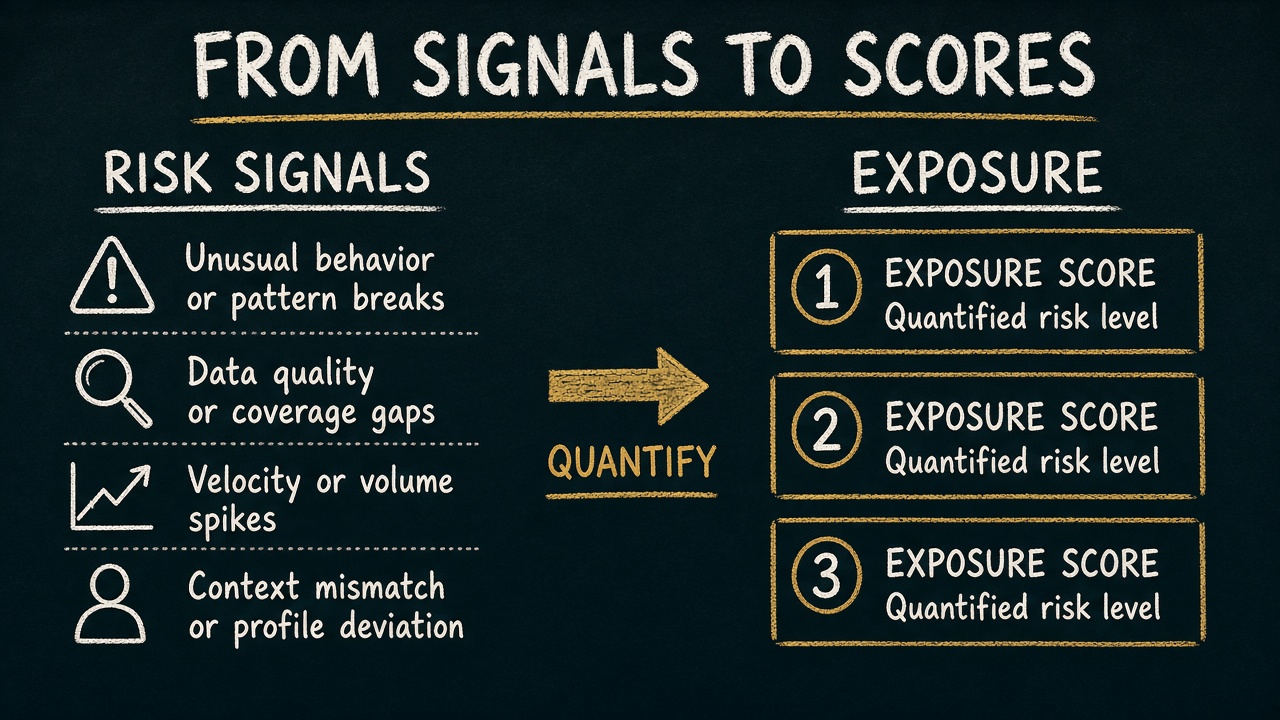
From Observation to Measurable Exposure
Risk signals on their own indicate potential issues.
Risk scoring translates those signals into a relative measure of exposure.
This allows:
- Comparison between different risks
- Prioritization of attention
- Better understanding of potential consequences
The Risk Scoring Model
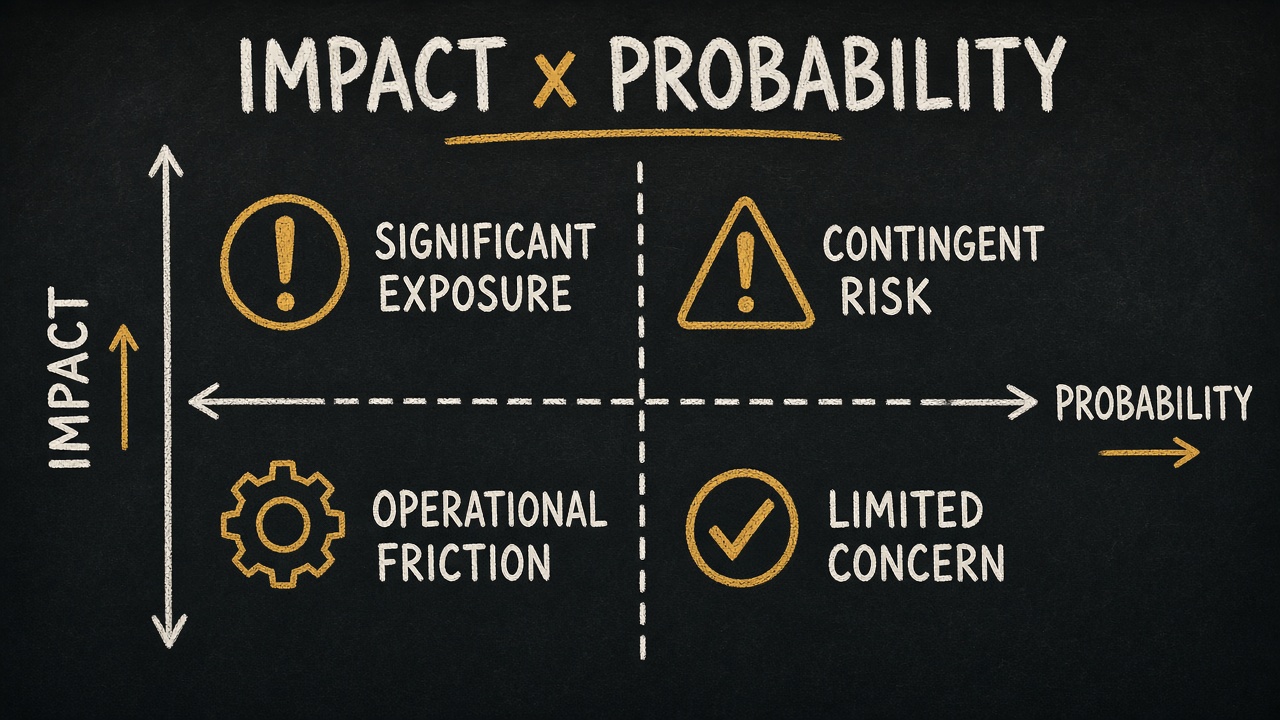
Impact × Probability
Each identified risk is evaluated using two components:
- Impact — the extent of potential consequences if the risk materializes
- Probability — the likelihood that the risk will occur under current conditions
The combination of these two factors produces a risk score that reflects overall exposure.
Interpreting the Relationship
This relationship ensures that scoring reflects both severity and likelihood, not just one dimension.
- High impact + high probability → Significant exposure
- High impact + low probability → Contingent risk
- Low impact + high probability → Operational friction
- Low impact + low probability → Limited concern
Defining Impact in AI Projects
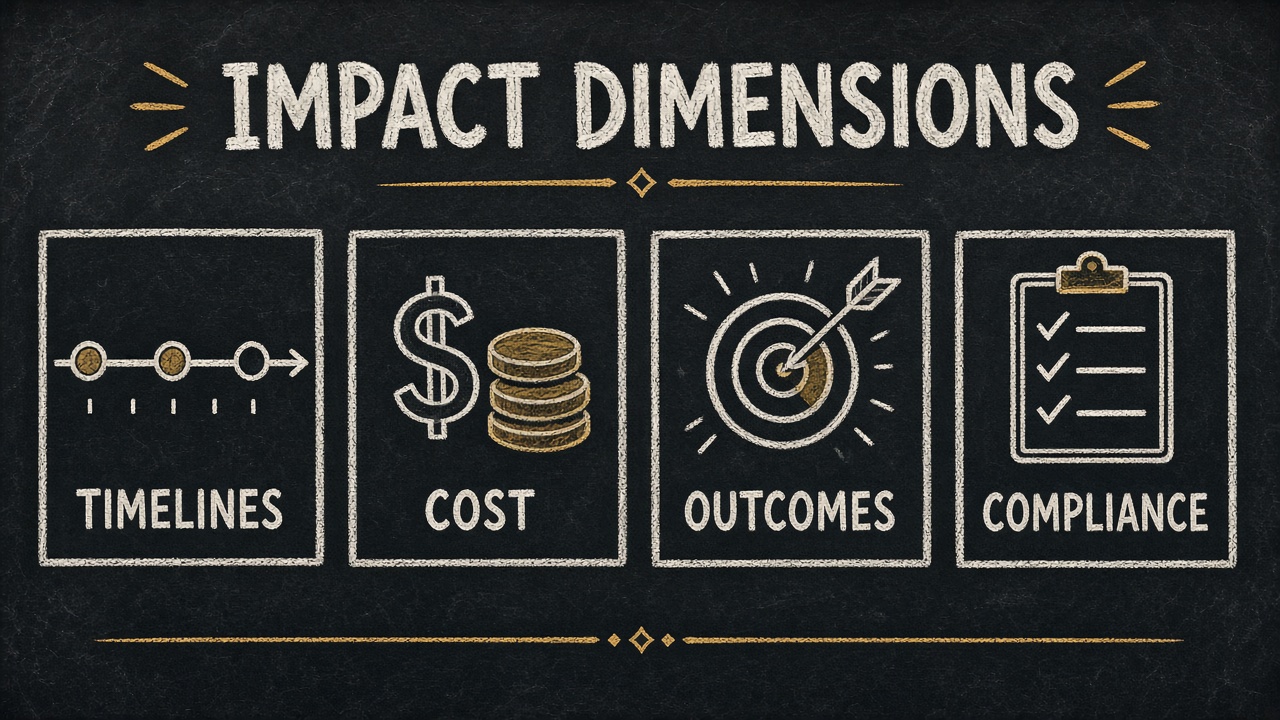
Dimensions of Impact
Impact is evaluated in terms of how a risk may affect:
- Project timelines
- Investment efficiency and cost
- Quality or effectiveness of outcomes
- Compliance or regulatory exposure
Impact is interpreted within the context of the specific AI initiative, not as a generic measure.
Contextual Nature of Impact
The same issue may have different impact depending on:
- The stage of the project
- The role of the affected component
- The criticality of the use case
This ensures that impact reflects real consequences, not abstract severity.
Estimating Probability
Probability as Condition-Based Likelihood
Probability is not treated as a statistical prediction.
It reflects the likelihood of occurrence based on current project conditions.
This includes:
- Alignment between stages
- Readiness of inputs such as data
- Stability of assumptions
- Dependency on unresolved factors
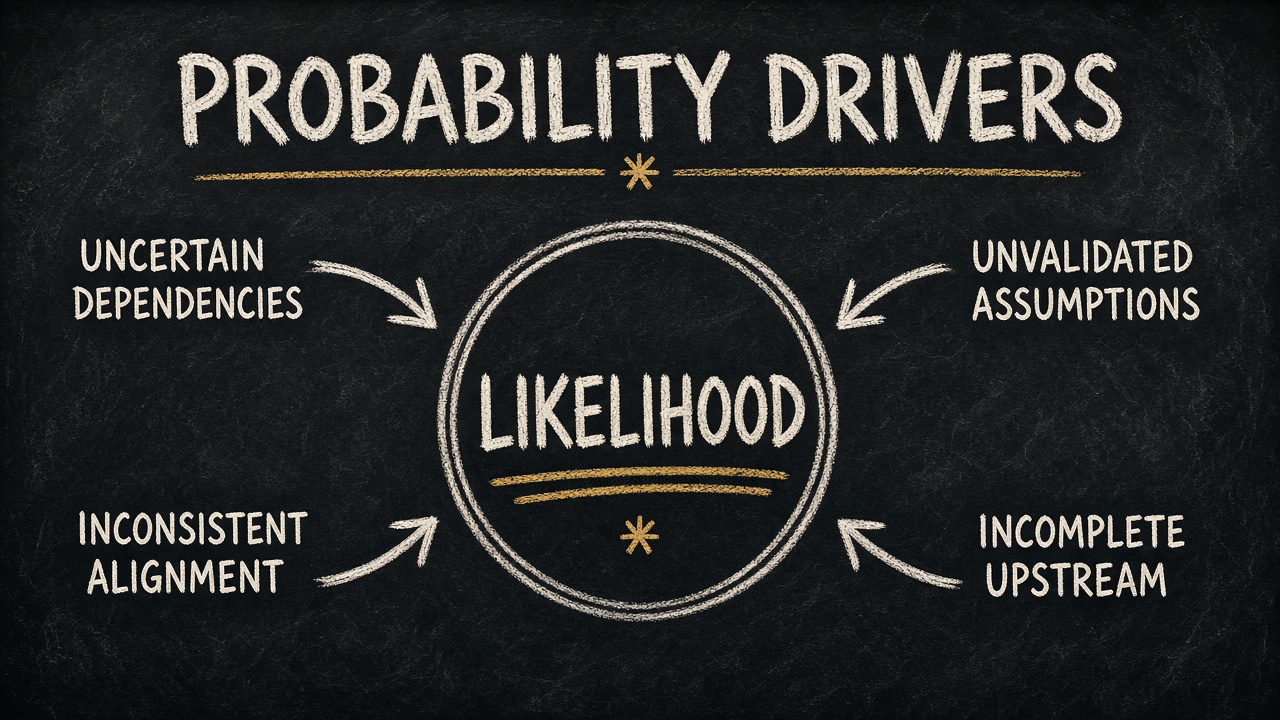
Indicators of Higher Probability
Probability increases when:
- Key dependencies are uncertain
- Assumptions are unvalidated
- Stakeholder alignment is inconsistent
- Upstream conditions are incomplete
This approach ties probability directly to observed project realities.
From Individual Scores to Risk Prioritization
Relative Comparison of Risks
Risk scores are used to compare:
- Which risks require immediate attention
- Which risks can be monitored
- Which risks have limited impact
This enables a structured prioritization approach without relying on subjective judgment alone. It also supports later executive decisions.
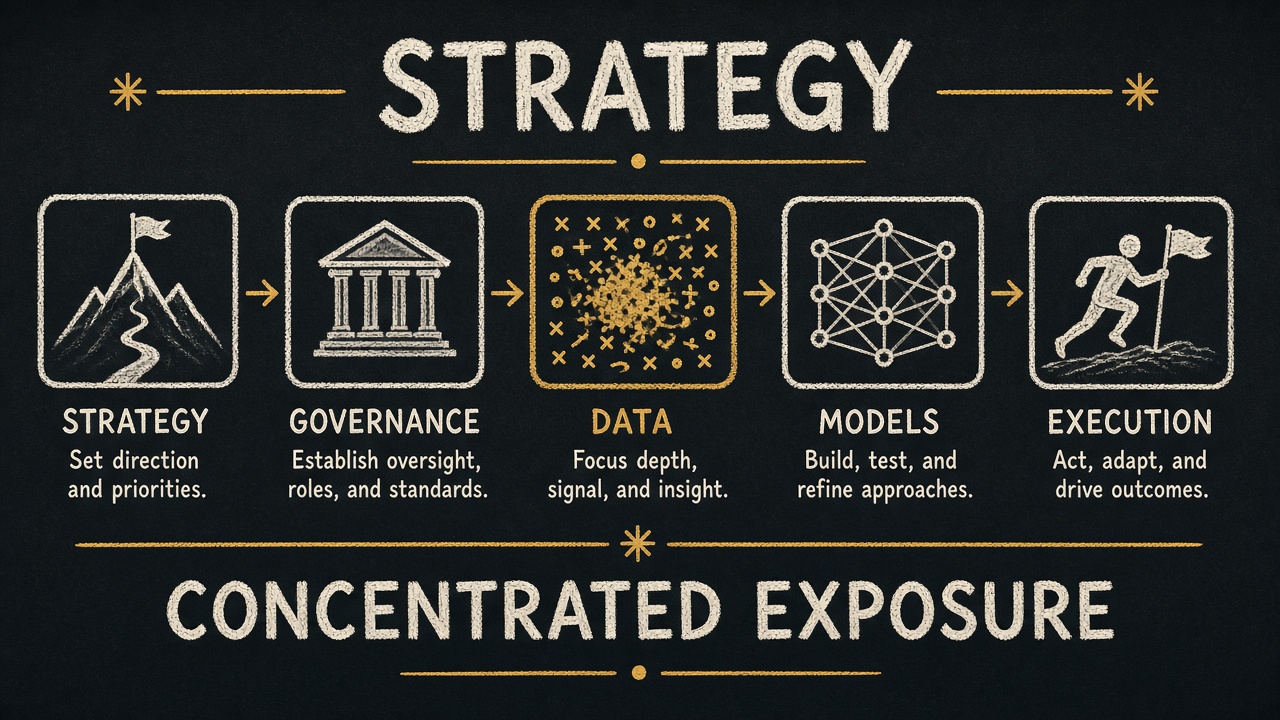
Identifying Concentrated Exposure
When multiple risks cluster around:
- A specific stage
- A particular dependency
- A shared assumption
This may indicate a higher concentration of exposure, even if individual scores vary.
Interpreting Risk Scores Responsibly
Not a Prediction Model
Risk scores do not predict outcomes with certainty.
They indicate:
- Where exposure exists
- Where attention may be required
- Where conditions increase likelihood of issues
Avoiding False Precision
Scores are not intended to imply exact numerical accuracy.
They are:
- Directional indicators
- Relative measures of exposure
- Tools for prioritization
This ensures the assessment remains grounded and credible.
Why Risk Scoring Matters
Structured Decision Support
Risk scoring provides a consistent basis for:
- Evaluating competing risks
- Allocating attention and resources
- Understanding potential impact before issues occur
Linking Signals to Action
By combining impact and probability, risk scoring helps translate:
- Observations → into measurable exposure
- Exposure → into prioritized focus
This bridges the gap between risk identification and informed decision-making.