




Insurance Companies

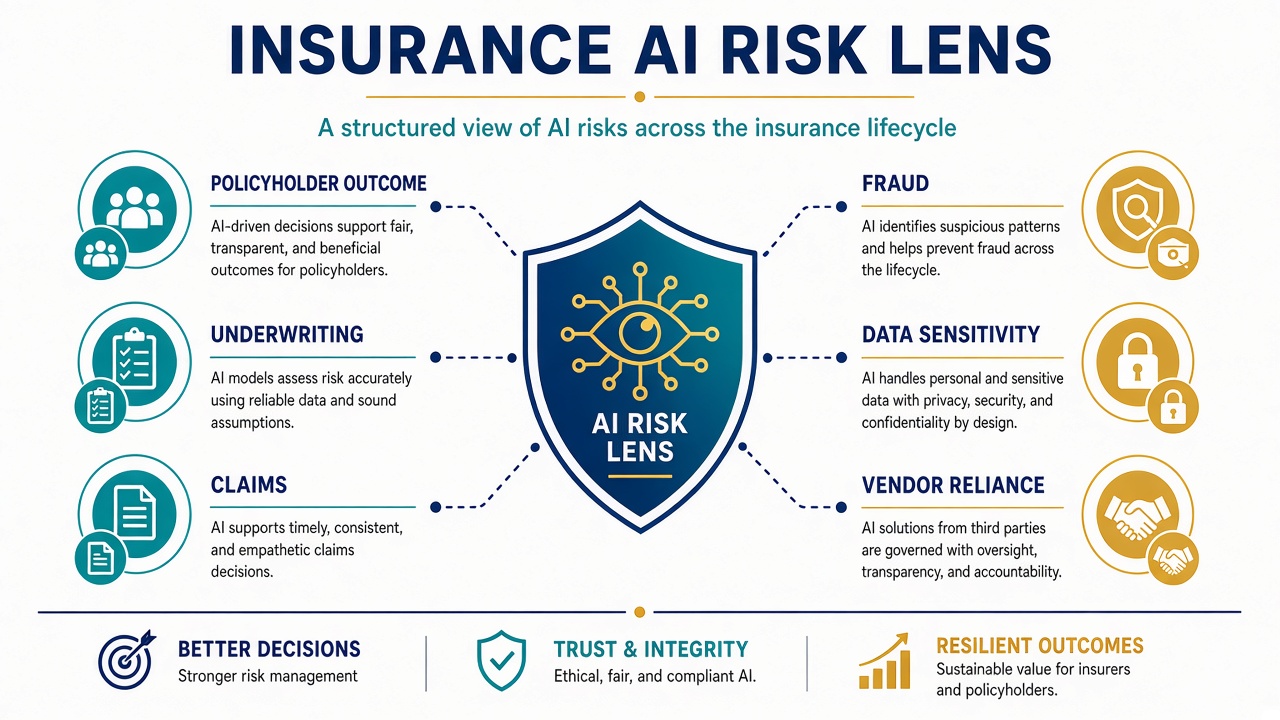
Insurance companies are adopting AI across underwriting, pricing, claims, fraud detection, customer service, policy administration, distribution, actuarial analysis, and internal operations. These initiatives can improve speed, consistency, and insight, but they may also affect customer treatment, reserving assumptions, claims outcomes, data governance, model oversight, and regulatory confidence.
AI Project Risk helps insurers assess active AI projects already in pilot, procurement, implementation, or production. We review the project through the relevant AI Project Pillars, available project evidence, sponsor input, and benchmark references to identify risk signals, control gaps, and practical management actions.
The outcome is a concise executive view of whether the AI project appears suitable for its current use, where exposure may exist, and what should be strengthened before wider adoption.
AI Risk Assessment for Insurance Environments
AI in insurance often sits close to customer outcomes. It may influence whether a risk is accepted, how a claim is handled, how fraud is flagged, how pricing inputs are interpreted, or how customers are segmented and serviced.
For executives, the central question is whether the AI project improves business performance without creating unacceptable exposure in conduct, fairness, explainability, data use, operational resilience, or regulatory scrutiny.
AI Project Risk supports assessment of active AI projects across areas such as:
- Underwriting decision support
- Claims triage and settlement workflows
- Fraud detection and investigation prioritisation
- Pricing and rating support
- Actuarial analysis and reserving support
- Policy administration and document processing
- Customer service chatbots and response assistants
- Broker, agent, and distribution support tools
- Marketing segmentation and retention models
- Internal productivity tools handling confidential information
- Vendor platforms with embedded AI capabilities
The assessment is designed to help management distinguish useful AI adoption from exposure that requires stronger control.
Key Risk Questions for Insurers
Could the AI project affect policyholder outcomes?
We consider whether the project may influence underwriting, pricing, renewal, claims handling, complaints, exclusions, servicing standards, or communications with policyholders, claimants, brokers, or agents.
Is the AI output explainable enough for the business use?
Insurance decisions often require defensible rationale. We assess whether users can understand, challenge, document, and escalate AI-supported outputs where appropriate.
Are fairness and conduct risks visible?
Where AI affects customer treatment, segmentation, claims handling, or pricing support, we identify indicators that may require closer review, monitoring, or management challenge.
Is sensitive insurance data being handled appropriately?
Insurance AI projects may involve health data, claims histories, financial information, behavioural data, location data, telematics, third-party data, employee information, or confidential commercial records. We assess whether data exposure and control expectations are proportionate.
Are claims, underwriting, and fraud controls still effective?
AI can alter workflow priority, case routing, triage thresholds, documentation quality, and user reliance. We review whether existing controls remain suitable after AI is introduced.
Is vendor AI sufficiently understood?
Many insurers adopt AI through claims systems, underwriting platforms, fraud tools, analytics providers, document automation, customer service software, and cloud services. We assess whether vendor oversight, data use, model transparency, resilience, and contractual protections may require strengthening.
Relevant Insurance Risk Areas
Underwriting and Pricing Support
Review of AI projects that support risk selection, pricing inputs, rating interpretation, eligibility checks, referral decisions, or underwriting productivity.
Claims and Customer Outcomes
Assessment of AI used in claims intake, triage, settlement support, document review, fraud flagging, repair estimation, customer communications, or complaint handling.
Fraud and Financial Crime
Review of AI used to detect suspicious claims, prioritise investigations, identify network fraud, monitor anomalies, or support special investigation units.
Actuarial and Reserving Support
Assessment of AI tools used to support analysis, assumptions, trend identification, forecasting, reserving inputs, or management reporting.
Distribution and Servicing
Review of AI applied to broker support, agent enablement, lead scoring, customer segmentation, retention activity, servicing automation, or digital advice support.
Operations and Third-Party Platforms
Assessment of AI embedded in policy administration, document processing, workflow automation, contact centre tools, analytics platforms, and outsourced service arrangements.
Executive Outputs
Typical outputs for insurance clients include:
- Insurance AI Project Risk Summary
- Policyholder and Customer Outcome Observations
- Underwriting, Claims, Fraud, or Pricing Risk Findings
- Data Sensitivity and Confidentiality Review
- Model and Output Reliability Observations
- Vendor and Embedded AI Risk Notes
- Governance and Accountability Findings
- Control Gap and Evidence Summary
- Benchmark Reference Notes
- Priority Management Actions
- Remediation Roadmap
- Committee Briefing Summary, where required
These outputs help insurance executives determine whether an active AI project can continue under current controls, requires remediation, should be escalated, or needs stronger evidence before expansion.
Benchmark and Regulatory References
Where relevant, observations may be informed by insurance-focused governance, conduct, operational resilience, model risk, data protection, outsourcing, and AI risk management references.
References may include the NIST AI Risk Management Framework, EU AI Act readiness considerations, model risk management principles, insurance supervisory expectations, fair treatment and conduct principles, data governance standards, third-party risk guidance, and three-lines-of-defense governance models.
Benchmark references support assessment and prioritisation. They are not presented as legal advice, regulatory approval, audit assurance, actuarial opinion, or formal compliance determination.
Request an Executive Briefing
If your insurance business has active AI projects in underwriting, claims, fraud, pricing, customer service, operations, or vendor platforms, AI Project Risk can provide a focused assessment of exposure, control gaps, and remediation priorities.